
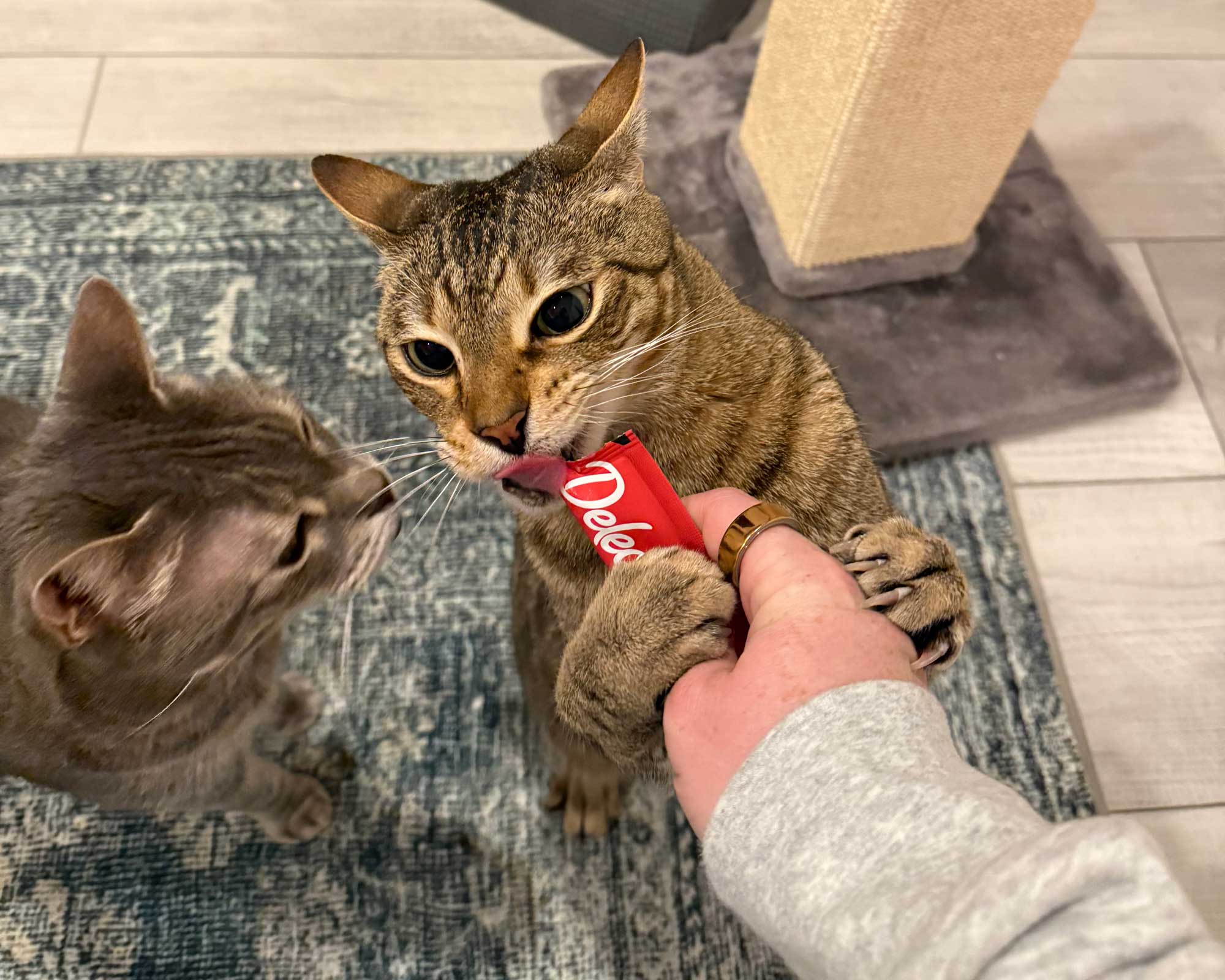

Ever tried to feed your cat and gotten frustrated when they licked all the gravy off their plate and left the actual food behind? Same. When you’re dealing with kidney disease in cats, you meet a whole new level of picky eater. Even my cat, previously one of the best eaters in the house, turned into a total gravy princess the day after his diagnosis.
Don’t fight the gravy obsession. Once we embraced it, we had way more success keeping our cat eating consistently. We switched him to an all-gravy diet (his favorite was the WERUVA BFF OMG lineup), and on the extra-fussy days, we’d use a low phosphorus gravy as either an incentive topper or a snack on its own. Here’s our updated, currently-accurate list of the best gravy for cats with kidney disease, including a couple of newer options that weren’t around when I first wrote this post.
Why Gravy for Cats?
Cats go wild for gravy because that’s typically where a lot of the flavor-enhancing additives end up. Commercial cat food often has ingredients added to entice cats to eat, and those tend to concentrate in the liquid, not the meat itself.
Gravy is also genuinely useful if you’re trying to get your cat to take in more fluids. Hydration is a huge deal for cats with chronic kidney disease (CKD), since their kidneys are less able to concentrate urine and conserve water on their own. A hydrating gravy topper is a low-effort way to sneak in extra moisture at every meal.
The catch: not all gravy is created equal when phosphorus is a concern. Some of the most popular gravy and broth toppers on the market are surprisingly high in phosphorus, which is exactly what a CKD diet is trying to limit. That’s why every product below is listed with its actual phosphorus number, not just a “vet approved!” sticker.
How to Read a Phosphorus Label (So You’re Not Guessing)
Quick primer, because this trips a lot of cat parents up: pet food labels usually list nutrients as-fed (as they come out of the can, including all the water weight), which makes wet food look artificially low in everything. What actually matters for comparing foods is the dry matter basis (DMB) — phosphorus as a percentage of the food once the water is removed.
Every product below is listed in DMB percentages so you’re comparing apples to apples. As a general rule of thumb that many CKD resources cite, foods under roughly 0.5% phosphorus DMB are considered on the lower end for cats with kidney disease — but the right target for your cat depends on their CKD stage, bloodwork, and what your vet recommends, so treat these numbers as a starting point for that conversation, not a substitute for it.
One more thing I’ve learned the hard way: manufacturers reformulate. The percentage that was accurate two years ago isn’t guaranteed to be accurate today. If a specific number really matters for your cat, it’s worth a quick email to the manufacturer to confirm current levels before you buy a case.
Best Low-Phosphorus Gravy Options for Cats with Kidney Disease
Here’s the quick-reference version, sorted lowest phosphorus to highest, before we get into details on each:
| Product (lowest-phosphorus flavor) | Phosphorus (DMB) |
|---|---|
| Weruva Wx Phos Focused, Chicken & Tilapia in Gravy | ~0.35% |
| Weruva Wx Phos Focused, Chicken Formula in Gravy | ~0.42% |
| Tiki Cat Broth Pouches, Chicken in Broth | 0.47% |
| Friskies Lil’ Soups, with Shrimp | 0.48% |
| Dave’s Pet Food Kidney Support Stew, Chicken & Vegetable | 0.62% |
| Tiki Cat Broth Pouches, Tuna in Broth | 0.65% |
| Tiki Cat Stixs, Chicken Mousse | 0.86% |
| Tiki Cat Silver, Tuna & Mackerel in Broth | 0.88% |
| Tiki Cat Stixs, Tuna Mousse | 1.08% |
Weruva Wx Phos Focused
This is the one addition to this list I’m genuinely excited about. Weruva built this line specifically for phosphorus-sensitive cats. This one is not a repurposed regular food, it’s engineered from the ground up around naturally low-phosphorus proteins like boneless chicken breast, tilapia, and egg whites, with no bone meal or fillers used to fake a lower number.
It comes in real gravy format (not just broth or purée), which makes it an easy swap for anything else on this list. Because the phosphorus is so low, it’s labeled for supplemental/intermittent feeding rather than as a complete diet — same category as everything else here, so nothing changes about how you’d use it as a topper or treat.
| Flavor | Phosphorus (DMB) |
|---|---|
| Chicken & Tilapia Formula in Gravy | ~0.35% |
| Chicken Formula in Gravy | ~0.42% |
Tiki Cat Stixs

I stumbled on these a while back, and my gravy lover totally gobbled them up. If your cat is anything like mine, this creamy mousse will make them come running. You can feed it “Gogurt-style” straight from the tube, or squeeze it onto a plate. It also works well as a meal topper if you’re trying to add incentive to a bowl of regular food.
| Flavor | Phosphorus on DMB% |
| Chicken Mousse | 0.86% |
| Tuna Mousse | 1.08% |
Tiki Cat Broth Pouches

If your cat loves anything soupy, this is a match made in heaven. It’s low-calorie and meant to complement your cat’s existing complete diet — you can pour it over any meal or offer it alone as a treat. It’s also free of grains, sugar, salt, starch, by-products, fillers, and artificial flavors or colors.
Heads up: not every flavor in this line is CKD-friendly. Duck & Chicken, for example, runs around 1.63% phosphorus DMB. This is way too high for a kidney diet. Stick to the flavors below.
| Flavor | Phosphorus on DMB% |
| Tiki Cat Broths Tuna in Broth with Meaty Bits | 0.65% |
| Tiki Cat Broths Chicken in Broth with Meaty Bits | 0.47% |
Friskies Lil’ Soups

My guy LOVES these! He can’t say no to gravy and these soup bowls are much thicker than a broth like the above option from Tiki Cat.
Note not all flavors are a great match for a CKD diet. Here are the flavors that we found to be better suited for our cats with kidney disease.
| Flavor | Phosphorus on DMB% |
| Flaked Chicken in a Velvety Tuna Broth | 0.62% |
| Friskies Lil’ Soups with Shrimp | 0.48% |
| Friskies Lil’ Soups with Chicken and Butternut Squash | 0.60% |
| Friskies Lil’ Soups with Sockeye Salmon in a Velvety Chicken Broth | 0.60% |
| Friskies Lil’ Soups Skipjack Tuna in a Velvety Tuna Broth Senior Formula | 0.60% |
| Friskies Lil’ Soups Tuna in a Velvety Chicken Broth | 0.62% |
Tiki Cat Silver
A reader asked me to add this a while back since it’s marketed specifically for senior and kidney-conscious cats, so here it is — with an honest caveat. Tiki Cat Silver is a nice line (real shredded meat in broth, added turmeric and green tea extract, no grains), but I want to be straight with you: its broth flavors actually run higher in phosphorus than the standard Tiki Cat Broth Pouches above, not lower. It’s a good option if your cat won’t touch anything else on this list, but it’s not the lowest-phosphorus choice here.
| Flavor | Phosphorus (DMB) |
|---|---|
| Chicken in Chicken Broth | 0.90% |
| Tuna & Mackerel in Tuna Broth | 0.88% |
| Mousse & Shreds, Chicken/Salmon/Liver | 1.08% |
Dave’s Pet Food Kidney Support Stew (New Addition)
This one’s worth knowing about if you’re watching cost, it’s a budget-friendlier non-prescription option built around a chicken and vegetable stew with added broth for hydration. It’s not the lowest phosphorus on this list, and a few readers online have noted it’s not every cat’s favorite flavor-wise, but it’s a reasonable middle-ground option if the pricier boutique brands aren’t in the budget every month.
| Flavor | Phosphorus (DMB) |
|---|---|
| Chicken & Vegetable Stew | 0.62% |
Baby Food for Cats
There are a few options for baby food that you can give to your cat, for more you can read our whole article on it here. I’ll just share my preferred pick below.
Beech-Nut Stage 1

Honestly, this is still my favorite. It only has two ingredients, broth and meat! The simplicity cuts out the added starch you’ll find in the Gerber brand. Beech-Nut makes Chicken, Turkey, and Beef options.
As always: when buying baby food for your cat, double-check the ingredients every time. There should be nothing beyond meat and broth — no seasonings, and absolutely no onion or garlic powder.
Make Your Own Gravy for Cats
Maybe store bought food just isn’t the best for your cat. No worries cat gravy is actually a really easy thing to make right from home. I have found that I am making more things at home for myself and my cats with shortages at the grocery store and sometimes dealing with cat food being sold out.
Here is a simple cat gravy recipe you can make:
1. Combine any excess pieces you have of chicken, pork, beef etc. into a large pot. If you are unsure, this includes skin, fat, organs, and even bones! Don’t have leftover parts from say a whole chicken or turkey you recently made? I would buy a pack of bone and skin on chicken thighs and boil that up. Even getting a pack of fresh chicken livers would be another great add, the organ meat is packed with vitamins and minerals for your cat.
2. Fill the pot with water to the top. Do NOT add any seasoning. Most kitchen seasonings are not safe for your cat. I would even skip the step of adding salt as many cats with Kidney Disease deal with high blood pressure and salt isn’t good for that. Keep in mind you meat probably has added sodium already.
3. Bring to a boil and turn down until it drops to a simmer. Place the lid of the pot on and let simmer for 2-3 hours, stirring occasionally.
4. Let cool. Strain so there is nothing left but the liquid. Portion out and freeze in ice cube trays. Thaw a cube for a simple gravy to place on top of your cats next meal.
FAQ: Gravy for Cats with Kidney Disease
Is gravy bad for cats with kidney disease?
Not inherently — it depends entirely on the specific product. Some commercial gravies and broths are surprisingly high in phosphorus and sodium, which can work against a kidney-friendly diet, while others (like the low-phosphorus options above) are genuinely good choices. Always check the dry matter phosphorus percentage rather than assuming “gravy” is automatically safe or unsafe.
What phosphorus level is safe for a cat with kidney disease?
This varies by cat and by CKD stage, so there’s no single universal number. Many CKD-focused resources point to roughly 0.5% phosphorus DMB or lower as a general target for supplemental foods, but your vet can give you a number tailored to your cat’s bloodwork and stage of disease.
Can I mix low-phosphorus gravy with my cat’s prescription kidney food?
Many cat parents do this successfully to boost palatability and hydration. Since prescription renal diets are already formulated to be low in phosphorus, adding a genuinely low-phosphorus gravy on top generally won’t undo that work — but it’s worth running past your vet, especially if your cat is on additional supplements like phosphate binders.
Why does my cat only eat the gravy and leave the food?
This is extremely common with CKD cats, especially as nausea from kidney disease sets in. It doesn’t necessarily mean something is wrong beyond the disease itself, but a sudden total refusal of food (not just pickiness about texture) is worth flagging to your vet, since it can signal nausea that’s manageable with anti-nausea medication or an appetite stimulant.
Are lickable purées like Churu okay for cats with kidney disease?
Some are fine, but many popular lickable purées weren’t designed with phosphorus restriction in mind and can run higher than the options on this list. Check the manufacturer’s phosphorus numbers the same way you would for any gravy or broth before making it a regular part of the diet.
How much gravy topper should I give a cat with kidney disease?
These products are meant as supplemental toppers or treats, not a full meal replacement, so a tablespoon or so per meal is typical for most cats. Your vet can help you fit it into your cat’s overall calorie and nutrient needs, especially if weight loss is already a concern.
Conclusion
Don’t pass up a good hydrating treat for your cat just because it’s “extra.” When a cat has kidney disease, hydration is one of the biggest levers you have — the more water you can get into them, the more you’re helping their kidneys flush out toxins they can’t filter as well on their own. Every cat is different, so it’s worth trying a few of these to see what your cat actually wants to eat, and always loop your vet in on the specifics for your cat’s stage of CKD.
Nothing on this site should override guidance from your veterinarian — I’m just sharing what’s worked in our own house.
Hi, thank you for your blog. It has brought me so much relief and sanity trying to feed my 15-year old cat who has k/d and is a picky eater. Do you know what the phosphorus level is for the salmon and duck & chicken flavors of the TikiCat Broth? I don’t see any info on phosphorus on Tiki’s website. Thank you.
I reached out to Tiki Cat they said Duck and Chicken has 1.63% phosphorous on a dry matter basis. This in my opinion is too high for a cat with CKD. Their Chicken broth is the lowest at 0.47% but the Salmon and Tuna is pretty good at 0.60% and 0.65% respectively
The tiki silver have a much lower % of phosphorus and is better designed for cats with kidney disease. these %’s are too high. ive got a phosphorus blocking powder that helps with other foods and thankfully any taste it may have doesnt turn her off. But if your cats kidneys are failing try Tiki Silver not these others. my cat isnt a fan of chucks but a quick run through the magic bullet and shes happy. shes get those on bad days she doesnt want to eat. but I think you arent giving people good advice. what you are recommending is still too high in phosphorus.
Great recommendation! Tiki cat silver is newer and wasn’t out when this was written. I will get it added to the list. As for the others listed it’s important to remember people need options, every cat is so different. My CKD girl loves her chunks and won’t touch the tiki cat food my CKD boy however was such a ham for puree food (we got a blender to smooth chunky food). At the end of the day our cats need to eat, and I agree a higher quality food will help them survive longer, I swear up and down over raw homemade food but having been on such a journey I know time and cost isn’t feasible for everyone (we still aren’t able to feed all our cats raw at all their meals). I have had to babies with this terrible disease and they weren’t the same, don’t eat the same food, etc. Sorry you having to deal with this horrid disease. I am just sharing our journey hoping it may help some others nothing on this site should override medical advice!